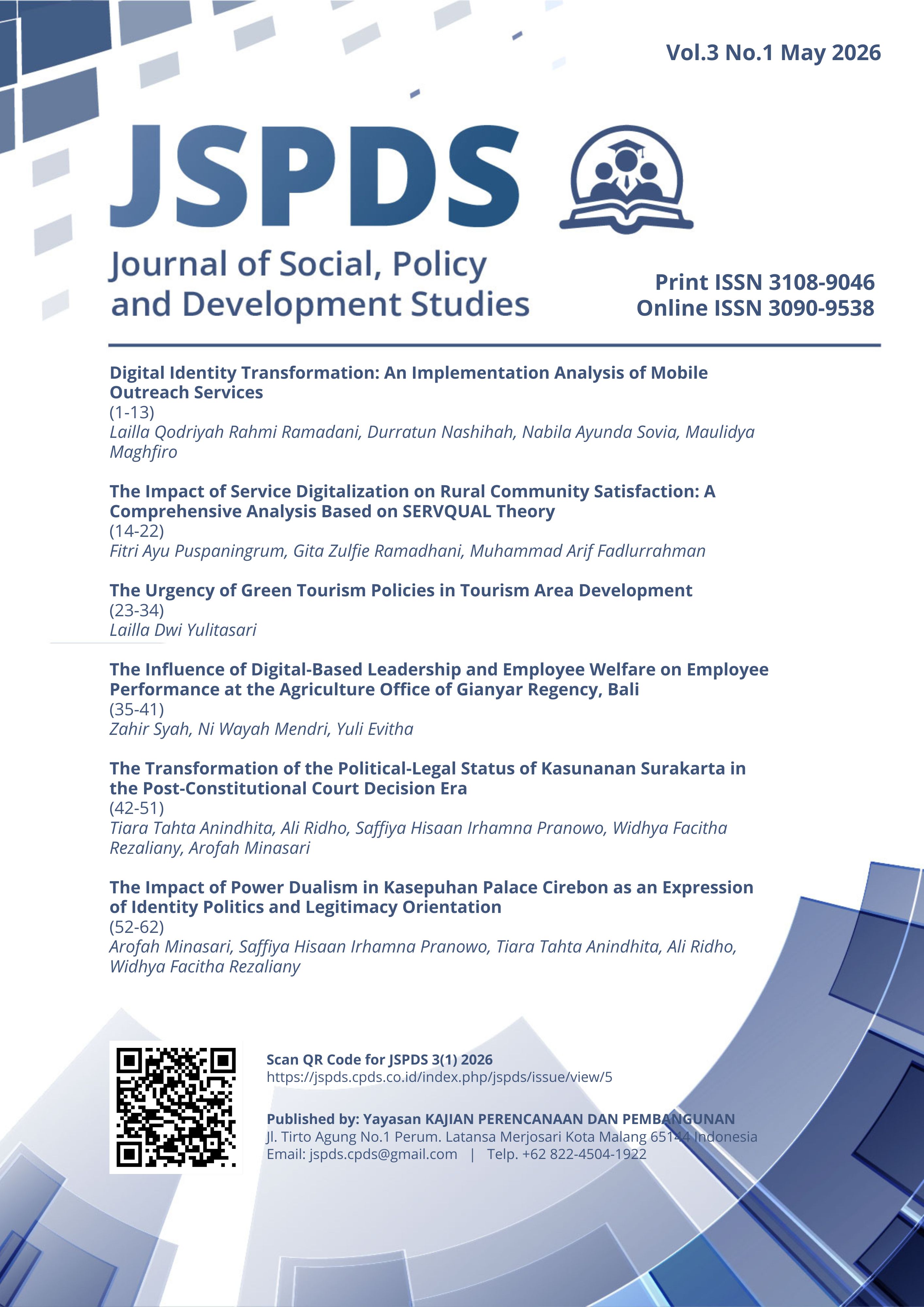
Digital Identity Transformation: An Implementation Analysis of Mobile Outreach Services
DOI:
https://doi.org/10.65119/jspds.v3i1.59Keywords:
Public service, Digital population identity, Mobile outreach programAbstract
The administrative population services are quite close to the legal identity of the citizens. Public services are nevertheless hampered by issues such as damaged, updated, lost identity cards (KTP) and limited access to electronic KTP blanks. To solve these problems, the government launched the Digital Population Identity initiative (Identitas Kependudukan Digital/IKD) as a part of the digital transformation agenda in the public administration. However, the number of IKD users in the City of Malang is still very low when compared to the number of residents who have registered electronic KTP. In response, the Population and Civil Registration Office of Malang City carried out the Mobile Outreach Program (Jemput Bola) to promote access and public engagement in digital identification services. This research seeks to analyse the execution of the Mobile Outreach Program on Digital Population Identity services at the Population and Civil Registration Office of Malang City. This is a descriptive study with a qualitative methodology. The data collection techniques used include observation, interview and documentation, while the data analysis technique used is the interactive model of Miles, Huberman and Saldana which consists of data condensation, data display and conclusion drawing. The findings indicate that the program implementation has been largely successful. Communication with the implementers and the community is well established. The attitude of the service officers is responsive and kind in service delivery. The bureaucratic framework and standard operating procedures have also aided in effective implementation. However, there are still certain obstacles such as insufficient human resources, inadequate supporting facilities, low smartphone specs of citizens and concerns about personal data protection. The study revealed that proactive outreach techniques can increase the adoption of digital services and narrow digital access gaps in local public services.
References
Andriani, & Rulandari, N. (2024). Evaluation of application of principles good governance in public services in Jekan Raya District, Palangka Raya City. Politeia: Journal of Public Administration and Political Science and International Relations, 2(4), 248–260.
Angow, F. O., Kiyai, B., & Kolondam, H. F. (2018). Implementasi kebijakan pelayanan publik di Dinas Kependudukan dan Pencatatan Sipil Kabupaten Bolaang Mongondow. Jurnal Administrasi Publik, 4(65), 191. https://ejournal.unsrat.ac.id/index.php/JAP/article/view/22056
Dewi, R. C., & Suparno. (2022). Mewujudkan good governance melalui pelayanan publik. Jurnal Media Administrasi, 7(1), 78–90. https://doi.org/10.56444/jma.v7i1.67
Edwards III, G. C. (1980). Implementing public policy. Congressional Quarterly Press.
Lusa, S. (2024). E-government issues in developing countries using TOE and UTAUT frameworks: A systematic review. Policy & Governance Review, 8(2), 169–191. https://doi.org/10.30589/pgr.v8i2.932
Melati, S., Setyawan, D., Merry, R., Wulandary, C., & Pamilar, D. (2025). Model integratif implementasi kebijakan digital: Sintesis Edward III dan digital governance pada sistem pengaduan sosial Kota Malang. CERMIN: Jurnal Penelitian, 9(2), 668–681. https://doi.org/10.36841/cermin_unars.v9i2.6961
Millensyah, E. W. (2024). Dinamika governance, 14(02), 199–207.
Ombudsman of the Republic of Indonesia. (2020–2023). Annual reports/public complaint reports on population administration services [Data report].
Rahmadana, M. F., Mawati, A. T., Siagian, N., Perangin-angin, M. A., Refelino, J., Tojiri, M. Y., Siagian, V., Nugraha, N. A., Manullang, S. O., Silalahi, M., Yendrianof, D., Sari, A. P., Supriadi, M. N., Sari, M. H. N., & Bahri, S. (2020). Pelayanan publik (J. Sim, Ed.). Yayasan Kita Menulis.
Rahmawati, L., Sya, A., Urahmah, N., Studi, P., Publik, A., Tinggi, S., & Administrasi, I. (n.d.). Implementasi identitas kependudukan digital (IKD) di Dinas Kependudukan dan Pencatatan Sipil, 25–30.
Ramadhani, O. O., Azizah, A. M., & Hidayati, A. D. (2026). Adopsi identitas kependudukan digital (IKD) untuk transformasi layanan publik Dinas Kependudukan dan Pencatatan Sipil Kota Magelang, 5143–5156.
Riani, N. K. (2021). Strategi peningkatan pelayanan publik. Jurnal Inovasi Penelitian, 1(11), 2443–2451. https://doi.org/10.47492/jip.v1i11.489
Sanjaya, Y. C. A. (2023). Sudah ada e-KTP, kenapa pemerintah terapkan IKD? Ini jawaban Dukcapil. Kompas.com. https://www.kompas.com/tren/read/2023/12/11/150000465/sudah-ada-e-ktp-kenapa-pemerintah-terapkan-ikd-ini-jawaban-dukcapil?page=all
Sasongko, R. W. (2023). Implementasi identitas kependudukan digital di Kabupaten Bandung. Jurnal Registratie, 5(1), 69–86. https://doi.org/10.33701/jurnalregistratie.v5i1.3148
Sugiartini, P., Tamamiyah, L., Cirebon, U. M., Islam, U., Bangsa, B., & Publik, A. (2024). Inisiatif e-government di Indonesia sebagai upaya meningkatkan pelayanan dan, 8(4), 950–955.
Sugiyono. (2013). Metodologi penelitian kuantitatif, kualitatif dan R&D. Alfabeta.
Supriyanto, D., & Noegroho, A. (2024). Media sosial dalam efektivitas komunikasi pelayanan publik instansi pemerintah daerah, 4, 7796–7810.
Wahab, S. A. (2001). Analisis kebijaksanaan: Dari formulasi ke implementasi kebijaksanaan negara (2nd ed.). PT Bumi Aksara.
Yuliana, S., & Anita, D. (2026). Pelayanan publik digital sebagai instrumen peningkatan kepercayaan masyarakat terhadap pemerintah, 4(4), 13973–13980.
Downloads
Published
Issue
Section
License
Copyright (c) 2026 Journal of Social, Policy and Development Studies

This work is licensed under a Creative Commons Attribution-ShareAlike 4.0 International License.